

‘Measuring at the pipe’ provides insight into actual emissions from mobile equipment
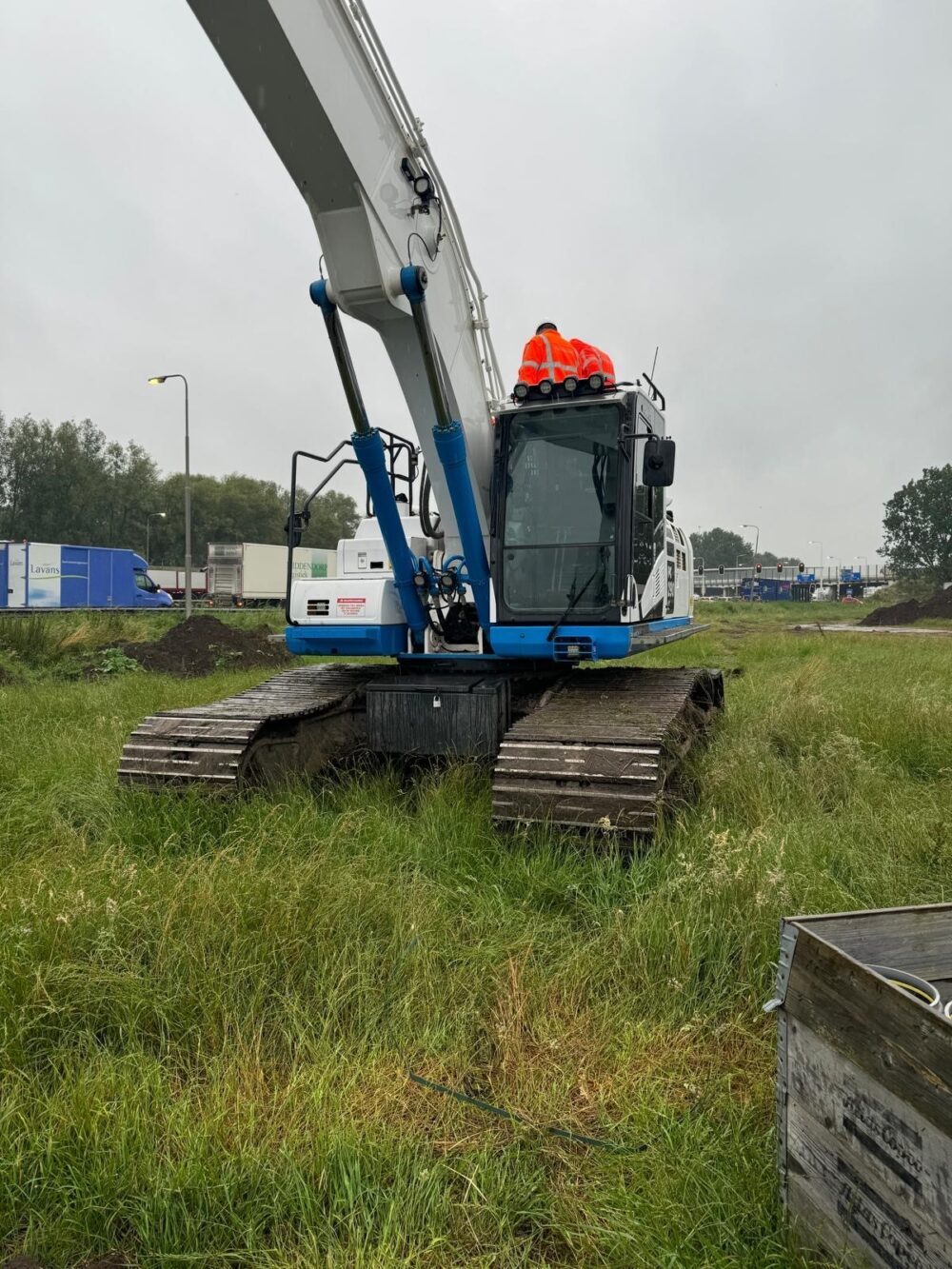
Within the Clean and Emission-Free Construction (SEB) knowledge and innovation program, large-scale efforts are being made to accurately determine the emissions of mobile equipment. TNO plays an important role in the ‘Meten aan de pijp’ (Measuring at the pipe) project by transferring knowledge about NOx monitoring to measurement parties, including Fleets-Online. This means that actual emissions, for example of NOx and nitrogen, are continuously monitored using sensors and then validated.
Thanks to an extensive set of sensors on a Komatsu PC290 excavator—and soon on other machines as well—data is collected on fuel consumption, AdBlue, exhaust temperature, and more. This data can be used to compare the calculated emissions (according to the AUB method) with the actual measured emissions. The insights help the construction sector make more conscious choices in the use of equipment and work towards a uniform and accurate measurement method for emissions from mobile machinery.
Insight into emissions of harmful substances with support from the Province
With stricter environmental standards on the horizon, construction, landscaping, and civil engineering companies need to report their emissions with increasing accuracy. Fleets Online, supported by the Province of Gelderland, is developing an integrated system that brings together emissions data from various sources, making reporting faster, more accurate, and cheaper.

Increasingly stringent environmental standards are forcing companies in the construction, infrastructure, landscaping, and civil engineering sectors to map their emissions of harmful substances more accurately. Governments therefore increasingly want a detailed and reliable overview of emissions so that both the permit process and compliance with environmental regulations can be better monitored. Previously, this was largely done using a variety of methods, such as emission meters, calculation models, telematics systems, and remote sensing equipment. Although these methods can provide valuable data, they are time-consuming in practice and do not always provide the desired accuracy.
In addition, many organizations lack an integrated approach. Data is often scattered across different data sources, which not only leads to a heavy administrative and reporting burden, but also increases the risk of human error. When calculating project costs in advance and retrospectively, it is essential to have a quick and accurate overview of total emissions in order to avoid unpleasant surprises. These could include exceeding emission limits or fines for non-compliance with environmental requirements.
Fleets Online responds to this need by developing a platform that centrally bundles data from all these sources. Instead of manually collecting and combining data, companies will soon be able to rely on a single automated solution that makes the process more accurate and cost-efficient. This minimizes the work involved in emission calculations and reporting, making it easier to comply with the increasingly stringent requirements imposed on construction and infrastructure projects.
To substantiate and further refine the feasibility of this platform, Fleets Online is currently conducting a study with the support of the Province of Gelderland. The aim is to identify the technical and organizational steps required to deploy the solution on a large scale. In doing so, Fleets Online is taking an important step in supporting the sector in achieving sustainability goals and complying with ever-increasing environmental obligations.